
The Corfu Old Fortress is another hot spot when touring the Corfu Old Town. Known as Paleo Frourio in Greek its entrance is from Spianada square

During the day entrance cost is 6€ for adults, 3€ for seniors and free for kids. In the evening the entrance is free because some areas and facilities are closed.
Once inside you’ll find several exhibits all with an accompanying information display explaining what they are and their history. You can’t go into most of the fort buildings as they are not part of the attraction and some have been repurposed e.g. The English Barracks of the Old Fortress of Corfu functions as the Public lending library.
The only buildings of this huge complex that are open to the public, include the Church of St. George and the Small Museum of Byzantine Collection located in the gatehouse.
You can climb up to the top where there is a lighthouse. The way there is uphill and has also steps. It is best to wear flat shoes as it can get a bit tricky to climb otherwise.
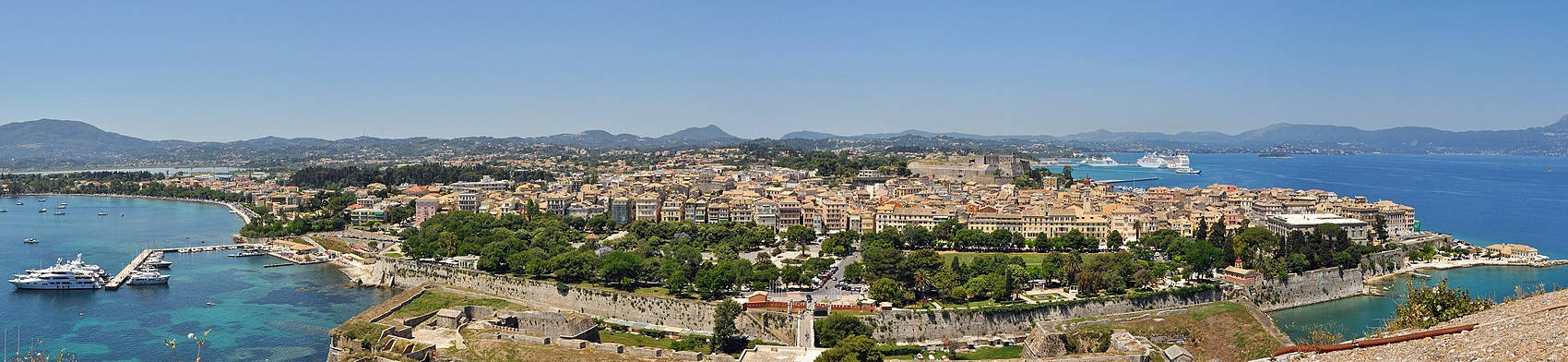
Once at the top, you are rewarded with a 360-degree panoramic view as far as the eye can see. On a clear day, you will be able to see the Greek mainland and Albania on the east. Westerly you have a bird’s eye view of Spianada Square, Liston, The old town, New Fort and the rest of the island’s landscape.
Brief History of Corfu Old Fortress
Around the 6th century AD after the Ostrogoths’ destruction of the ancient city of Corcyra, the inhabitants sought shelter inside the natural fortifications on the peninsula at the edge of the city. There were no military developments for many centuries until The Byzantines started to add fortifications.
Once the Venetians took over the occupation of the island in the 15th century they started to replace and upgrade the old Byzantine fortifications. They dug down and created the Contrafossa an artificial moat. This is a sea channel connecting the Gulf of Kerkyra to the North with the Bay of Garitsa to the South. The addition of the moat effectively converted the citadel into an artificial island as it separated it from the mainland. At the time a wooden drawbridge was used to enter but later on, it was replaced by the British with the present permanent bridge that stands 15 meters above sea level.
The fort successfully repulsed all three major Ottoman sieges: the great siege of 1537, the siege of 1571 and the second great siege of Corfu in 1716.
During the British Occupation (1814-1864) big interventions were made with the construction of several buildings mostly of military nature. These included barracks, a military hospital, and The Church of Saint George (Garrison church for British troops).
What is in The Fortress
- The Church of Saint George (used to be British Garrison Church).
- Museum of Byzantine artefacts
- Ruins of a former British hospital
- Exhibits dotted around the complex (Cannons, Catapults etc)
- Coffeeshop (Serving food and Drink)
- Corfu Sailing Restaurant
- Gift Shop
- Toilets
When Should I Visit?
Explore the Old Fort primarily entails strolling through its expansive grounds, admiring the exterior of its structures, and enjoying the panoramic views. While museums are typically indoor sanctuaries for rainy days, the Old Fort is best appreciated in fair weather conditions, unless you come prepared with complete rain gear. Optimal visiting times are during pleasant weather. However, if you find yourself there during the scorching heat of peak summer months, ensure you’re well-equipped with ample water, sunscreen, and perhaps even a hat. Climbing to the summit can be challenging in intense heat, particularly for some individuals.